










Contractor Classification in Qatar, Explained
If you are appointing a contractor in Qatar, classification is the single most useful credential to ask about — and the one most clients never check.
Classification is a formal assessment by the State of what a contracting company is competent and financially sound enough to undertake. It is not a trade licence, and it is not the same thing as a commercial registration. A company can hold both of those and still not be classified at all.
Who issues classification
Classification certificates are issued by the Government Procurement Regulatory Department (GPRD) at the Ministry of Finance.
Companies wanting to bid for government contracts in Qatar must be classified in one of three roles:
- Contractor — carries out construction works
- Service provider — supplies services
- Supplier — supplies goods and materials
A company is assessed on its size, experience, financial standing and technical capability. The result determines what scale of government work it is permitted to bid for.
Specialisations
Within the contractor sector, classification is granted against a specialisation, not across construction generally. The recognised specialisations include:
- Buildings
- Roads
- Sewage
- Water
- Agricultural works
A contractor classified in Roads is not thereby classified in Buildings. When you are checking a contractor's standing, the specialisation matters as much as the grade — a strong classification in the wrong specialisation tells you very little about their competence on your project.
What the categories control
Classification is graded into categories. The category determines the maximum contract value the company may undertake within its specialisation.
The specific value ceilings attached to each category are not published in a single authoritative public list, and they are periodically revised. Rather than repeat figures that may be out of date, the reliable approach is to ask the contractor for their certificate and read the ceiling stated on it — every certificate states its own limits explicitly.
To make that concrete, here is ours.
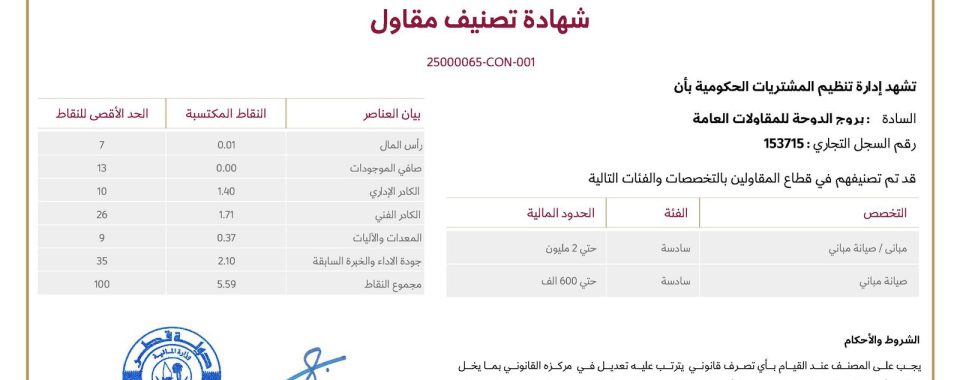
A worked example: our own certificate
Brouj Doha General Contracting holds:
| Classification | Contractor — Category Six |
| Specialisation | Buildings |
| Certificate number | 25000065-CON-001 |
| Ceiling — Buildings & Building Maintenance | up to QAR 2,000,000 |
| Ceiling — Building Maintenance | up to QAR 600,000 |
| Issued under | State of Qatar Tahfeez programme |
| Valid | 5 November 2025 to 4 November 2027 |
That is what a classification certificate actually tells you: the role, the specialisation, the value ceiling, the certificate number, and the validity window.
Why the ceiling is useful information, not a warning sign
Clients sometimes read a value ceiling as a limitation. It is better understood as a matching tool.
A contractor whose classification, staffing and track record are built around villas, compounds, fit-outs and maintenance contracts will deliver that work better than a firm geared for infrastructure megaprojects — who will either decline your villa or price it as an inconvenience.
The mismatch runs both ways. Appointing a contractor for work well above their classified ceiling is the more serious error, and it is one classification exists specifically to prevent.
How to verify a contractor before appointing them
Ask for four things. Any legitimate contractor will produce them without hesitation.
1. The classification certificate. Check the specialisation matches your project type, the ceiling covers your contract value, and the validity dates are current. Certificates expire — ours runs to November 2027.
2. The Commercial Registration (C.R.). Confirms the company legally exists and what activity it is registered for. Ours is 153715, activity code 4100001, Construction & General Contracting.
3. The Commercial Licence. Issued by the Registration and Commercial Licenses Department at the Ministry of Commerce and Industry. Ours is 195563.
4. Qatar Chamber membership. Confirms standing within the business community.
You can also consult Monaqasat, the unified State procurement portal at monaqasat.mof.gov.qa, for the official position on government procurement classification.
What classification does not tell you
Classification is a floor, not a guarantee. It confirms the State has assessed a company as competent and solvent for a certain scale of work. It says nothing about whether they finish on time, communicate well, or leave a site clean.
For that you need the things classification cannot certify: a project record you can check, clients you can speak to, and a site you can visit.
Frequently asked questions
Is classification mandatory for private projects? No. It is required to bid for government work. For private projects it is voluntary — which is exactly why it is a useful signal. A privately focused contractor who holds classification has chosen to be assessed when nobody obliged them to.
Can a contractor exceed their classified ceiling on a private job? Classification governs government procurement. On private work, the ceiling is best read as an indication of the scale the company is resourced and assessed for. Appointing well above it is a risk you are choosing to take.
How long does classification last? Certificates carry explicit validity dates and must be renewed. Always check the dates rather than the existence of a certificate.
What is the Tahfeez programme? Tahfeez is the State of Qatar programme under which classification certificates of this kind are issued.
Checking a contractor's credentials? Ours are published in full on our Credentials & Licenses page — certificate numbers, ceilings and validity dates included. If you need certified copies for a tender or prequalification, contact us.