










Excavation in Qatar: What Ground Conditions Really Cost You
Excavation is the phase most likely to produce a number nobody budgeted for. Not because contractors are opportunistic, but because the ground is genuinely unknown until somebody looks — and on most projects nobody looks until the machines arrive.
The problem with Qatari ground
Qatar sits on limestone, and its behaviour is inconsistent in ways that matter.
Depth to rock varies sharply over short distances. Two plots on the same street can differ substantially, and rock depth can change within a single plot. The neighbour's experience is not evidence about yours.
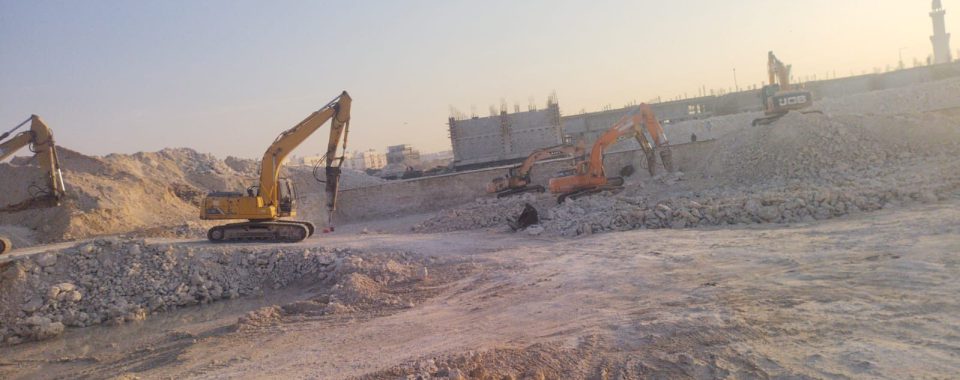
Rock excavation is a different operation entirely. Excavating workable ground is a matter of moving material. Excavating rock requires breaking it first — different plant, slower progress, higher cost per cubic metre. The difference is not marginal.
Groundwater appears in coastal zones. Near the coast the water table can be high enough to require dewatering during excavation, which adds plant, time and, where discharge is involved, its own requirements.
Fill material is unpredictable on developed plots. A plot previously built on or backfilled may contain material of unknown origin and quality. It frequently has to be removed and replaced rather than built on.
Ground can be chemically aggressive. In some areas the ground contains constituents that attack concrete and reinforcement. That changes the concrete specification for anything below ground — a design decision, not a construction one.
The investigation that prevents most of this
A geotechnical soil investigation is the single most cost-effective risk reduction available on any Qatari project.
It typically involves boreholes, sampling and laboratory testing, and it tells you depth to rock and its character, groundwater level, the bearing capacity available, whether the ground is chemically aggressive, and what the existing fill contains.
The point that matters: the investigation does not remove the cost of difficult ground. It moves the discovery forward in time, to the stage when you still have options.
Knowing you have rock at 1.5 metres before you finalise the design lets you reconsider whether a basement is worth it, adjust levels, change foundation type, and price the work properly. Discovering it after mobilisation gives you none of those choices, and you are negotiating a variation with work already underway.
The basement decision
The basement is the biggest single amplifier of ground risk.
A basement means substantially more excavation volume, possible rock across a much larger area, potential dewatering, retention or shoring where excavation is deep or adjacent to neighbouring structures, waterproofing to the entire below-grade envelope, and permanent drainage.
Every one of those is priced against ground conditions. The same basement on two different plots can differ enormously in cost.
This is not an argument against basements — they add valuable space on constrained plots, and we build them regularly. It is an argument for investigating the ground before committing the design to one.
Backfill: the part nobody watches
Excavation gets attention because it is visibly expensive. Backfill gets almost none, and it causes more long-term problems.
Fill placed in deep layers and compacted inadequately continues to settle for months or years. The consequences appear long after handover: cracked ground-floor slabs, settled driveways and external paving, fractured buried services, and gaps opening where a slab meets a wall.
Correct practice is straightforward: place fill in specified layers, compact each layer, and test to confirm the required density before placing the next. It is slower than tipping and levelling, which is exactly why it gets skipped.
When you review an earthworks quote, look for compaction in specified lifts with testing. If it is not mentioned, ask. The difference in price is small; the difference in outcome is not.
How to read an excavation quote
Is rock excavation included, excluded, or a provisional rate? This is the biggest variable. A quote that excludes rock is not comparable with one that includes it.
What is the assumed depth to rock? If the quote assumes a depth, the assumption needs to come from an investigation.
Is disposal included? Removing material off site has real cost. Confirm whether it is in the price.
Is dewatering included? Relevant on coastal plots.
Is backfill specified with compaction and testing? As above.
Is shoring included where needed? For deeper excavation or work adjacent to existing structures.
A quote that is silent on these is not cheaper. It is less complete, and the difference will arrive later as a variation.
Working next to existing structures
Site extension work — excavating beside a building already there — carries two specific risks.
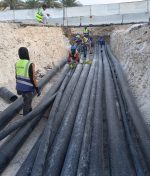
Service strikes. Trenching near live services is the highest-risk activity on most sites. Locating services before breaking ground is non-negotiable.
Undermining foundations. Excavating adjacent to an existing structure without understanding its foundation depth can compromise it. The existing foundations must be established before excavation begins alongside them.
We deliver this kind of work regularly, including site extension contracts in Al Sailiya, Al Kharaitiyat and Unaizah for QBC and Al Darwish Engineering.
What good looks like
An earthworks contractor worth appointing will survey before pricing, tell you what they find rather than absorbing it, price against a stated assumption and say what that assumption is, compact in specified layers with testing, locate services before breaking ground, and excavate to what the next trade actually needs.
That last point matters more than it sounds. Excavation that finishes to the wrong level or profile stalls the frame. Because we also build the structures, we excavate to the level the structure requires rather than to the level the drawing was read as saying.
Frequently asked questions
How much does a soil investigation cost? Considerably less than the variation it prevents. It is the cheapest insurance on the project.
Can you tell what is underneath from neighbouring plots? It is an indication, not evidence. Rock depth varies over short distances, sometimes within one plot.
What if we find rock after starting? It becomes a variation — priced under less favourable circumstances, with the programme already running. This is the situation an investigation exists to avoid.
Do you take excavation-only contracts? Yes. Much of our earthworks is delivered as standalone packages for main contractors and engineering firms.
Need an earthworks package priced properly? Request a quote — we survey before we give you a number. See also what it costs to build a villa in Qatar.